
The NMC’s Foreign Medical Graduate Licentiate (FMGL) Regulations, 2021 decide whether an MBBS from abroad lets you practise in India. They came into force on 18 November 2021. In short: qualify NEET first, study at least 54 months plus a 12-month internship at one foreign institution, then clear India’s screening test and internship. This guide explains each condition in plain English and how to read the advisories the NMC issues.
Quick answer: The FMGL Regulations, 2021 require a foreign medical graduate to have done a course of at least 54 months plus a 12-month internship in the same foreign institution, in English medium and covering the Schedule-I subjects; to hold a licence to practise in the country of the degree at par with its citizens; to complete a supervised internship in India of at least 12 months; and to clear the National Exit Test or other mandated test (the FMGE today). Indian students must also qualify NEET before taking admission abroad.
Key facts: the FMGL Regulations at a glance
| Notified | 18 November 2021 (Gazette of India); applies to students who enrolled on or after that date |
|---|---|
| Course length | At least 54 months of medical study, plus a 12-month internship in the same foreign institution |
| Language | English medium |
| Location | The entire course, training and internship outside India in the same foreign institution; no part in India or a third country |
| Time limit | The course must be completed within ten years of joining |
| Licence abroad | Registered or licensed to practise in the country of the degree, at par with that country’s citizens (Regulation 4(b)) |
| After return | Supervised internship in India of at least 12 months, and clearing the National Exit Test or other mandated test (FMGE today) |
| Earlier admissions | Students admitted before 18 November 2021 fall under the Screening Test Regulations, 2002 |
| Last reviewed | 18 November 2026 |
The core conditions
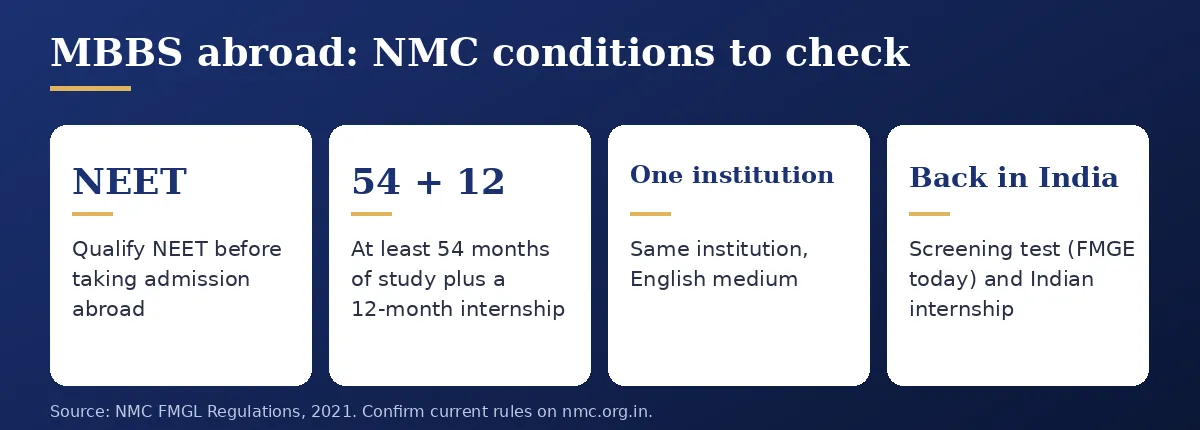
- NEET qualification before taking admission abroad.
- At least 54 months of medical study, plus a 12-month internship in the same foreign institution.
- The whole course at one institution in one country, taught in English medium.
- Passing India's screening test (the FMGE today) and completing the Indian internship before permanent registration.
The NMC’s published FAQ also says the course and internship should be commensurate with an Indian MBBS under the medical education regulations. The Embassy of India in Bishkek reproduces the regulation text on its student advisory page, which is a convenient primary-source copy.

Regulation 4 in plain English
The regulation sets the conditions for a foreign medical graduate to be granted permanent registration in India. As reproduced in the Embassy of India’s advisory, the graduate must have:
- (a) completed a foreign medical degree of at least fifty-four months, an internship of at least twelve months in the same foreign medical institution, a degree taught in English, and the mandatory subjects in Schedule-I;
- (b) registered with the professional regulatory body, or otherwise be competent to be licensed, to practise medicine in the country where the degree was awarded, at par with the licence given to that country’s citizens;
- (c) completed a supervised internship in India of at least twelve months, after applying to the Commission; and
- (d) cleared the National Exit Test or such other mandated test conducted by the Commission.
Point (d) is why the FMGE still applies today: NExT has been announced but deferred, and the FMGE is the “other mandated test” in practice. Point (b) is why Georgia and the Philippines have attracted attention in 2026, as explained in our country guides.
Schedule-I: the part most families do not read
Schedule-I sets the criteria for recognising foreign medical graduates. Key points:
- Guiding principle: the graduate must have education and training equivalent or commensurate with that of an Indian medical graduate.
- Duration and content: a course of theory, practical and clinical training equivalent to the Indian MBBS, plus a 12-month internship in the same institution with hands-on training in clinical subjects including Community Medicine, General Medicine, Psychiatry, Paediatrics, General Surgery, Anaesthesia, Obstetrics and Gynaecology, Orthopaedics, ENT, Ophthalmology, Dermatology, emergency or casualty services and laboratory services.
- Curriculum transparency: the curriculum should be available for review, and if necessary on the institution’s website, when you join.
- Location: the entire course, training and internship must be done outside India in the same foreign institution, with no part done in India or in any country other than the one that awarded the degree.
- Time limit: the course must be completed within ten years of the date of joining.
Each of these turns into a question you can ask a university in writing. The university verification guide has a ready-made list.
After you return to India
Foreign medical graduates sit the screening test, currently the FMGE conducted by NBEMS, and complete a compulsory internship in India before permanent registration. NExT has been announced but deferred, and secondary sources disagree on details, so see our guide to FMGE and NExT and confirm on nmc.org.in.
NMC and Embassy advisories: how to read them
The NMC has repeatedly warned students about non-compliant foreign institutions. Its 1 April 2026 Uzbekistan alert note refers back to public notices dated 8 August 2023 and 22 November 2024, an advisory dated 19 May 2025 and an alert note dated 21 July 2025. Indian embassies publish their own advisories: the Embassy in Bishkek in 2026 listed Kyrgyz institutes that did not pass state accreditation, and the Embassy in Manila issued a fresh advisory on Philippine MD programmes in June 2026.
How to read an advisory: find the date, find what exactly it says and to whom (an institution, a country or a practice), and check whether a later notice has changed it. A warning is not a ban, and the absence of a warning is not clearance. Read the Uzbekistan, Kyrgyzstan and Georgia pages for how this plays out country by country.
Not sure your shortlist is safe?
Share the universities you are considering and we will list what to verify for each, using the NMC conditions and any current advisory. Free first consultation.
Call +91 95400 01774What this means for your choice
- Ask for the course length in months, in writing.
- Confirm the internship is in the same institution.
- Check the NEET timing against your admission. See eligibility.
- Never rely on “compensation” certificates or verbal assurances.
- Keep every promise from a university or consultant in writing.
The full context is in our MBBS abroad guide.
Rules and advisories change. Confirm the current position on nmc.org.in and with the university in writing before you pay. We never promise admission, visas or exam results.
Frequently asked questions
What are the NMC guidelines for MBBS abroad?
The FMGL Regulations, 2021: qualify NEET before admission, study at least 54 months plus a 12-month internship at one foreign institution in English medium, then pass the screening test and the Indian internship.
When did the FMGL Regulations come into force?
On 18 November 2021. Earlier admissions fall under the older Screening Test Regulations, 2002.
Does the NMC recognise foreign universities?
The regulations set conditions a student’s programme must meet. The NMC does not simply approve countries, so check the specific programme and any advisories.
Can part of the MBBS be done in India or online?
No. Schedule-I requires the entire course, training and internship outside India in the same foreign institution.
Is there a time limit to finish the foreign MBBS?
Yes. The course must be completed within ten years of the date of joining.
Do I need a licence in the country where I studied?
Regulation 4(b) requires registration or competence to be licensed there, at par with that country’s citizens. This is why Georgia and the Philippines have attracted attention.
Why do I still take the FMGE if NExT was announced?
The regulation refers to NExT or another mandated test. NExT has been deferred, so the FMGE remains the test to plan for.
Where can I read the official rules?
On nmc.org.in. The Embassy of India in Bishkek also reproduces the regulation text on its student advisory page. Rules and notices change, so check the latest ones.
Sources and further reading
Official notices and reports used for this page: National Medical Commission: FMGL Regulations, 2021 and student advisories · Embassy of India, Bishkek: student advisory with the FMGL conditions (updated 23 April 2026) · Medical Dialogues: NMC alert note on Uzbekistan (2 April 2026) · Embassy of India, Manila: advisory of 17 June 2026. Media reports are secondary sources, so confirm each point against the NMC’s own notices and the official advisory pages.
Rules and advisories change. Confirm the current position on nmc.org.in and with the university in writing before you pay. We never promise admission, visas or exam results.