
Around 16,000 Indian students study medicine in Uzbekistan, according to the Indian Embassy in Tashkent. On 1 April 2026 the National Medical Commission issued an alert note saying that many FMGL criteria were not being fulfilled at certain institutions. Read this page before you consider any Uzbek university: it explains what the note says, what the Embassy said in response and how to check your own shortlist.
Quick answer: The NMC’s alert note dated 1 April 2026 cautions Indian citizens and OCI considering MBBS in Uzbekistan, citing FMGL violations at named institutions, including teaching that is not in English. The Embassy of India in Tashkent has described the note as precautionary, not a ban. MBBS in Uzbekistan is valid in India only if your specific programme meets the FMGL conditions, so verify the institute, the language of teaching and the internship in writing before paying.

Key facts: MBBS in Uzbekistan at a glance
| Indian students | About 16,000, according to the Indian Embassy in Tashkent |
|---|---|
| NMC note | Alert note of the Under-Graduate Medical Education Board dated 1 April 2026 |
| Concerns raised | FMGL criteria not fulfilled, medium of teaching not English, limited hands-on training, and enrolment concerns at some institutions |
| Embassy position | The note is precautionary and not a ban on the named universities, as reported in August 2026 |
| NEET | Required if you want to practise in India (FMGL Regulations, 2021) |
| Main risk to check | English-medium clinical training and a compliant 12-month internship in the same institution |
| Our position | We never promise admission, visas or FMGE results |
| Last reviewed | 18 November 2026 |
What the NMC alert note of 1 April 2026 says
The note was issued by the NMC’s Under-Graduate Medical Education Board for Indian students seeking admission to undergraduate medical courses in Uzbekistan. We have read the NMC’s note itself (No. U-15021/1/2024-UGMEB, dated 1 April 2026). In summary:
- Following communication from the Embassy of India in Tashkent, the NMC observed that many criteria under the FMGL Regulations, 2021 were not being fulfilled, and cautioned Indian citizens and OCI to exercise extreme caution.
- It named four institutions: Bukhara State Medical Institute (BSMI), Samarkand State Medical University (SSMU), Tashkent State Medical University (TSMU) and TIT Institute of Medical Sciences, Bangalore, described as an offshore campus of the TSMU Termez Branch.
- It raised concerns that the medium of instruction is not English, so students are not receiving hands-on training because of the communication gap, which makes it hard for Indian students to complete internship requirements.
- Relaying the Embassy’s communication, the note also reports that students are admitted beyond the intake capacity of the institute, and that serious concerns exist about malpractices by agents facilitating admissions. It specifically mentions complaints about the Termez branch of Tashkent State Medical University operating with an offshore campus in Bangalore, and testimonies from Indian students at Bukhara State Medical Institute who joined through a private contractor.
- It states that any deviation in course duration, medium of instruction, syllabus and curriculum, clinical training or internship arrangements may result in disqualification from registration in India, and tells students to verify recognition before paying, avoid unverified agents and report suspicious offers to the NMC.
The note followed earlier NMC notices. Its text refers back to public notices dated 8 August 2023 and 22 November 2024, an advisory dated 19 May 2025 and an alert note dated 21 July 2025. Read the NMC’s own notice for the exact wording and institution list, because lists change.
What the Indian Embassy in Tashkent said
The Embassy has said the alert note should be read as encouragement to verify FMGL compliance before taking admission, and that it continues to work with the Uzbek government and medical universities to help Indian students meet NMC requirements. In August 2026, Medical Dialogues reported, citing the Times of India, that the Embassy clarified the note is precautionary and does not amount to a ban on the named universities, and that the Haryana Medical Council made a similar point.
Two readings are both reasonable, and you should hold both in mind. The note does not close any university, and the Embassy says so. It also does not clear any university: it says that many FMGL criteria were not being fulfilled, and the NMC decides eligibility to practise in India. A reasonable family treats the note as a reason to ask harder questions in writing, not as a reason to panic or a reason to relax.
Is MBBS in Uzbekistan valid in India?
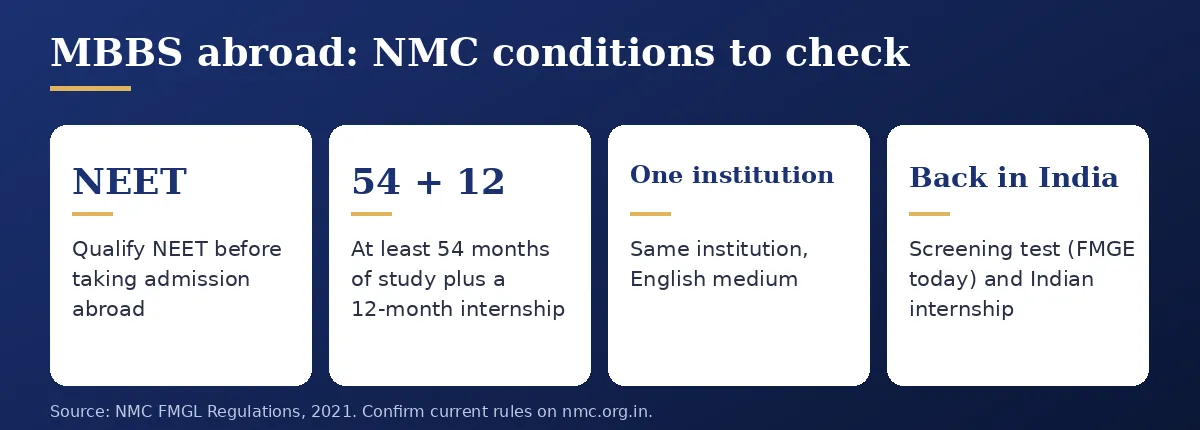
Only for programmes that meet the NMC conditions:
- NEET qualification before taking admission abroad.
- At least 54 months of medical study, plus a 12-month internship in the same foreign institution.
- The whole course at one institution in one country, taught in English medium.
- Passing India's screening test (the FMGE today) and completing the Indian internship before permanent registration.
The FMGL Schedule-I adds that the entire course, training and internship must be done outside India in the same foreign institution, and that no part of the medical training and internship may be done in India or in any country other than the one that awarded the degree. Any arrangement that places part of the course in India, online or in a different country should be treated as a serious red flag.
Why the language of teaching matters so much
The FMGL Regulations require an English-medium degree. The NMC’s concern in Uzbekistan is practical rather than technical: if lectures or clinical teaching are in Uzbek or Russian, an Indian student may sit in a ward without understanding the discussion or being able to take a history, which defeats the purpose of clinical training.
Ask each university these questions and keep the answers:
- Which batches are English medium, and is the English track the one you are joining?
- Are clinical rotations taught and examined in English, and who supervises Indian students on the ward?
- How much Uzbek or Russian will you need to speak with patients, and does the university offer language classes?
- What proportion of the faculty in your batch teaches in English?
What to verify before you pay
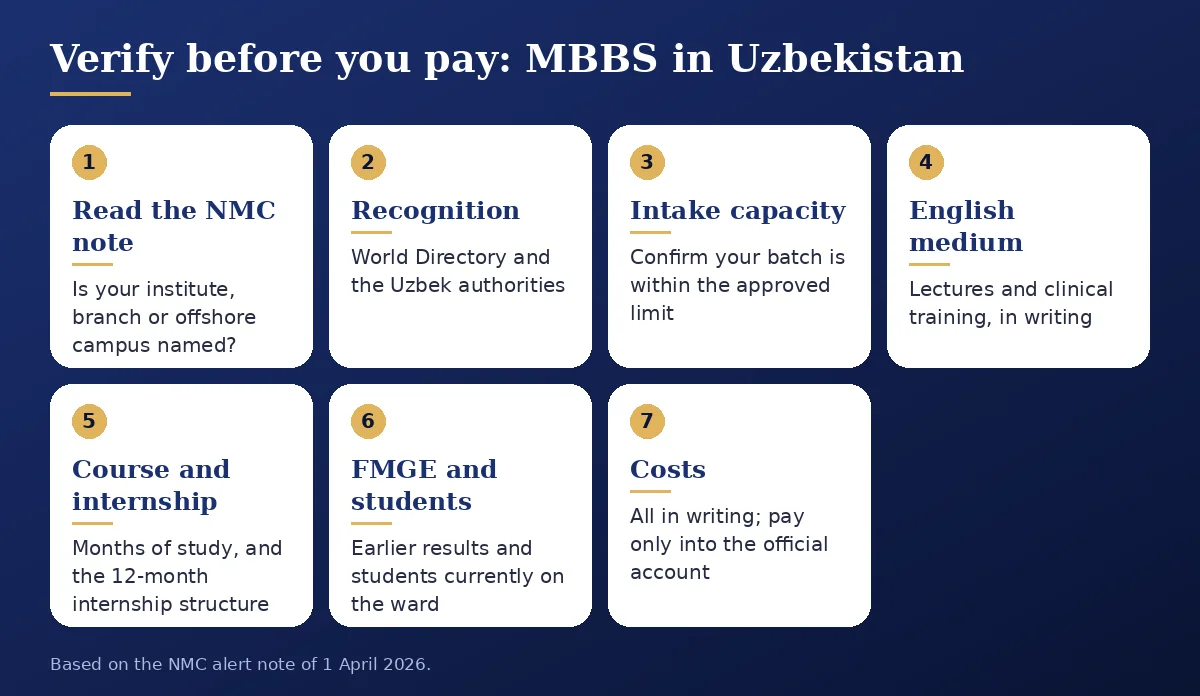
- Read the NMC note itself and check whether your shortlisted institute, or its branch or offshore campus, is named.
- Confirm recognition in the World Directory of Medical Schools and with the Uzbek authorities, remembering that a listing proves a school exists, not that it meets the FMGL conditions.
- Ask for the approved intake capacity and confirm that your batch is within it.
- Get English-medium teaching for lectures and clinical training confirmed in writing.
- Ask for the course length in months and the location and structure of the 12-month internship.
- Ask for FMGE results of earlier Indian graduates and talk to students currently on the ward.
- Get all costs in writing and pay only into the university’s official account. See our fees guide.
The full checklist, with questions you can copy into an email, is in our guide to choosing a medical university abroad.
Want a written second opinion before you pay anything?
Send us your NEET result, shortlist or offer letter. A counsellor will check it against the NMC conditions and tell you plainly what to ask. Free, with no payment or commitment.
Call +91 95400 01774Who should consider MBBS in Uzbekistan, and who should wait
It may suit students who have qualified NEET, who have a specific institute that is not named in an NMC notice, who can get English-medium teaching and a compliant internship confirmed in writing and who can afford the full programme. It is a poor fit if the institute is named in the note and cannot explain how it will meet each criterion, if the teaching is mostly in a local language, or if you are being pushed to pay quickly. Compare Kazakhstan, Georgia, Kyrgyzstan and Russia on the same checklist.
Related reading: NMC guidelines for MBBS abroad explained · Best countries for MBBS abroad · FMGE and NExT requirements.
Frequently asked questions
Did the NMC warn against MBBS in Uzbekistan?
Yes. An alert note dated 1 April 2026 flagged FMGL violations at named institutions and urged extreme caution. Read the notice itself for the current list.
Is the NMC advisory on Uzbekistan a ban?
No. The Embassy of India in Tashkent has described it as precautionary and not a ban on the named universities. It is still a warning that the FMGL criteria were reported as not being met, so verify your institute in writing.
Which Uzbek institutions did the NMC name?
The NMC note names Bukhara State Medical Institute, Samarkand State Medical University, Tashkent State Medical University and TIT Institute of Medical Sciences, Bangalore, an offshore campus of the TSMU Termez Branch. Check the NMC notice for the authoritative wording.
Is MBBS in Uzbekistan valid in India?
Only if the specific programme meets the NMC FMGL conditions, including English medium and a 12-month internship in the same institution. Do not rely on the country name.
Is the teaching in English?
It varies. The NMC raised concerns that the medium of instruction is not English at certain institutions, so get English-medium lectures and clinical training confirmed in writing.
Is NEET required?
To practise in India afterwards, yes. NEET qualification before admission is part of the FMGL Regulations, 2021.
Can part of the course be done in India?
No. The FMGL Schedule-I requires the entire course, training and internship outside India in the same foreign institution, so treat any programme that places part of it in India as a red flag.
Can a consultant guarantee compliance?
No. Be wary of anyone who promises it. Ask to see the supporting documents and verify them yourself with the university and the NMC.
Sources and further reading
Official notices and reports used for this page: NMC Alert Note and covering advisory dated 1 April 2026 (PDF hosted by Medical Dialogues) · Medical Dialogues: NMC warns against admission in Uzbekistan (2 April 2026) · Careers360: NMC warning on Uzbekistan medical colleges · Medical Dialogues: no admission ban on Uzbekistan universities (10 August 2026) · The Tribune: Embassy support for Indian MBBS aspirants in Uzbekistan. Media reports are secondary sources, so confirm each point against the NMC’s own notices and the official advisory pages.
Rules and advisories change. Confirm the current position on nmc.org.in and with the university in writing before you pay. We never promise admission, visas or exam results.