
Russia and Georgia both appeal to Indian students, and the NMC rules apply equally to both. What differs is the language you will need with patients, the climate, the cost structure and the specific watch point for each. Neither is automatically better: the university you choose matters more than the country. This comparison puts the differences side by side so you can ask the right questions.
Quick answer: Both countries require NEET, at least 54 months plus a 12-month internship in the same institution, English medium and the Indian screening test. Russia offers large state medical universities and published six-year totals of about ₹20 lakh to ₹45 lakh, but hospital work is usually in Russian and payment and travel conditions can change. Georgia offers a six-year MD with English-taught programmes, but the NMC’s September 2026 clarification on junior doctor status under Regulation 4(b) means you must verify eligibility in writing.
Key facts: Russia vs Georgia at a glance
| Degree and length | Russia: MBBS-equivalent, usually six years including internship. Georgia: Medical Doctor (MD), six academic years. |
|---|---|
| Teaching language | Russia: English batches, but hospital work usually in Russian. Georgia: English-taught programmes, but ask how much Georgian patients and staff use. |
| Published costs | Russia: tuition about ₹2.3 lakh to ₹7.5 lakh per year, six-year totals about ₹20 lakh to ₹45 lakh. Georgia: compare written fee schedules. |
| Main watch point | Russia: payments, flights and sanctions. Georgia: Regulation 4(b) and junior doctor status. |
| Scale | Georgia: an estimated 20,000 to 25,000 Indian students (Business Standard, October 2026). |
| Quality body | Georgia: MD programmes are accredited by NCEQE (list at eqe.ge). |
| Same in both | NEET, 54 months plus a 12-month internship in one institution, English medium, FMGE and the Indian internship |
| Last reviewed | 18 November 2026 |
What is the same
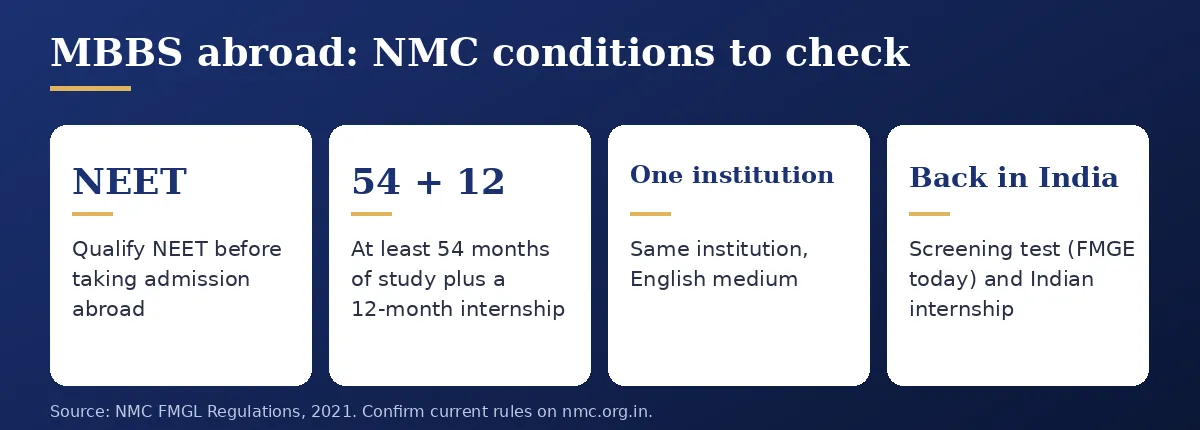
For both countries you must meet the NMC conditions:
- NEET qualification before taking admission abroad.
- At least 54 months of medical study, plus a 12-month internship in the same foreign institution.
- The whole course at one institution in one country, taught in English medium.
- Passing India's screening test (the FMGE today) and completing the Indian internship before permanent registration.

This is the point many comparison articles skip: the NMC rules do not favour either country. The choice is about the specific university and the risks around it.
Russia: what to weigh
- Large state medical universities and a long history with Indian students.
- Published tuition of about ₹2.3 lakh to ₹7.5 lakh per year at public universities, with hostel and living costs on top.
- Lectures may be offered in English, but hospital work usually involves Russian, so ask how much you will need and plan to learn it properly.
- Cold winters in many cities.
- Payment channels, flight routes and visa conditions can change quickly because of the Russia-Ukraine conflict and sanctions. Check the Ministry of External Affairs and the Indian Embassy in Moscow, and confirm with your bank how fees will be paid.
Read our detailed guide to MBBS in Russia.
Georgia: what to weigh
- English-taught programmes are widely offered, but ask how much Georgian is needed in hospitals.
- The degree is an MD over six academic years. Georgia’s quality body NCEQE was reported to say that MD programmes carry at least 360 ECTS credits and that the sixth year is a mandatory internship at the university’s clinical bases.
- The NMC clarified on 24 September 2026, replying to a grievance, that junior doctor status satisfies Regulation 4(b) only if it legally permits medical practice at the required level. Medical Dialogues, citing PTI, has reported that NMC responses on FMGE eligibility for Georgia graduates have not been consistent, with a further response dated 13 October 2026. Georgian officials have said that Georgian and foreign graduates have identical professional rights, including the right to hold a junior doctor position, as reported by The Tribune; whether that satisfies Regulation 4(b) is the NMC’s call.
- Because of this, ask exactly how the internship is structured and how the programme satisfies Regulation 4(b), and treat any “automatic eligibility” claim as unverified until backed by an NMC document.
Read our detailed guide to MBBS in Georgia.
Side-by-side comparison
| Regulatory watch point | Russia: mostly practical (payments, travel, accreditation of the specific university). Georgia: a live question on Regulation 4(b) and junior doctor status. |
|---|---|
| Language with patients | Russia: Russian. Georgia: Georgian, to a degree that varies by hospital. Ask both. |
| Cost transparency | Russia: published ranges exist; compare written schedules. Georgia: compare written schedules for all six years. |
| FMGE results | Published analyses reported around 30% of Indian graduates from Russian universities passed the FMGE in 2024, varying widely by university. For Georgia, ask each university for its own data. |
| Climate and daily life | Russia: cold winters, large student cities. Georgia: ask current students about city, hostel and food. |
| Risk if rules shift | Russia: payment or travel disruption. Georgia: eligibility interpretation by the NMC. |
These are not rankings. A strong Russian university with clean documents can beat a weak Georgian one, and the reverse is also true.
How to decide
- Compare two or three specific universities from each country.
- Get course length in months and the internship arrangement in writing.
- Ask for FMGE results of earlier Indian graduates from each university.
- Compare total cost with written schedules. See what to include.
- For Georgia, get a written explanation of how the programme meets Regulation 4(b). For Russia, ask how fees will be paid and what happens if the route fails.
Have an offer letter or fee quote you are unsure about?
Send it across. We will point out what is missing, such as month counts, internship terms and refund conditions. Free, no commitment.
Call +91 95400 01774Who might prefer which
Students comfortable with a cold climate and a new language, who want an established destination with a long history, and who accept payment and travel risk, may look at Russia first. Students who want English-taught clinical years and are comfortable that Regulation 4(b) is still being clarified, and who will get a written answer before paying, may look at Georgia. Students who need certainty today may prefer to wait or compare Kazakhstan and other options.
Rules and advisories change. Confirm the current position on nmc.org.in and with the university in writing before you pay. We never promise admission, visas or exam results.
See also best countries for MBBS abroad · NMC guidelines explained.
Frequently asked questions
Is Russia or Georgia better for MBBS?
Neither is better for everyone. Judge specific universities on NMC compliance, clinical training, results and cost.
Is the teaching in English in both?
English-taught programmes exist in both, but hospital work involves the local language. Ask each university how much you will need.
Do the same NMC rules apply?
Yes. NEET, 54 months plus a 12-month internship in the same institution, then the screening test and Indian internship.
Which is cheaper, Russia or Georgia?
It depends on the university and changes over time. Compare written fee schedules for all years.
What is the Georgia Regulation 4(b) issue?
Regulation 4(b) requires a licence to practise in the country of the degree at par with citizens. The NMC said in September 2026 that junior doctor status counts only if it legally permits that level of practice.
What are the risks of MBBS in Russia?
Payment channels, flights and visas can change quickly because of sanctions and the conflict, and hospital work usually requires Russian.
How many years is MBBS in Russia and Georgia?
Usually six years in both, with the internship included in the six in Russia and a mandatory internship in Georgia’s sixth year as reported. Get the month count in writing.
Can I switch between them after admission?
The FMGL expects the course and internship at one institution, so do not plan on switching. Decide before you pay.
Sources and further reading
Official notices and reports used for this page: National Medical Commission: FMGL Regulations, 2021 and student advisories · Careers360 (PTI): NMC on Georgia licence at par with citizens · Business Standard: Indian MBBS aspirants in Central Asia (27 October 2026) · The Tribune: Georgia clarifies recognition of Indian students · Medical Dialogues: junior doctor status in Georgia and FMGL. Media reports are secondary sources, so confirm each point against the NMC’s own notices and the official advisory pages.
Rules and advisories change. Confirm the current position on nmc.org.in and with the university in writing before you pay. We never promise admission, visas or exam results.