
Published six-year budgets for MBBS abroad commonly run from about ₹20 lakh to ₹50 lakh or more, depending on the country and university. A yearly tuition quote tells you little. A real budget covers the full course plus the costs around it, and every figure should be given to you in writing. This guide shows what to include, where the hidden costs sit and how to compare two universities on equal terms.
Quick answer: A realistic MBBS abroad budget is the sum of tuition for every year, hostel and food, one-time admission and visa costs, yearly insurance and permits, flights home, FMGE preparation, the Indian internship and a 10% to 15% reserve. Published six-year budgets commonly run from about ₹20 lakh to ₹50 lakh or more. The cheapest quote can cost more if the programme is not NMC-compliant, needs extra years or leads to repeated FMGE attempts.
Key facts: MBBS abroad fees at a glance
| Published six-year budgets | Commonly about ₹20 lakh to ₹50 lakh or more, depending on the country and university |
|---|---|
| Tuition range example | Published Russian tuition runs about ₹2.3 lakh to ₹7.5 lakh per year, with hostel and living costs on top |
| Reserve | Keep a 10% to 15% reserve for currency swings and emergencies |
| Compare using | Written fee schedules for all years, on the same cost list |
| Often forgotten | Visa renewals, insurance, flights, winter clothing, FMGE preparation and the Indian internship |
| Pass rate context | FMGE overall pass rate about 12.8% in June 2026, so quality of teaching matters more than the sticker price |
| Last reviewed | 18 November 2026 |
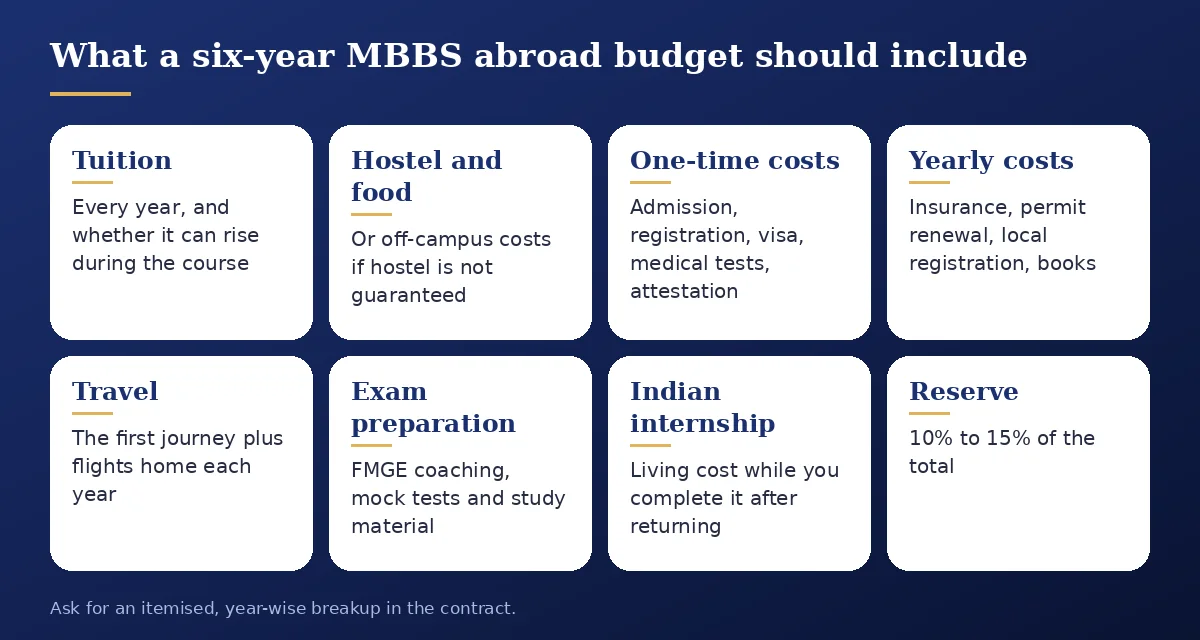
What a six-year budget should include
- Tuition for every year, and whether it can rise during the course.
- Hostel and food, or off-campus living costs if hostel is not guaranteed every year.
- One-time costs: admission, registration, application and visa fees, medical tests and document attestation.
- Yearly recurring costs: health insurance, visa or residence-permit renewal, local registration and books, uniforms and lab fees if charged separately.
- Travel: flights home each year you plan to travel, plus the first journey.
- Exam preparation: FMGE coaching, mock tests and study material.
- The Indian internship after you return, and the living cost while you complete it.
- A reserve of 10% to 15% of the total.
Build the figure year by year in a simple sheet. Our student living costs guide helps you estimate items three and four.
A worksheet you can copy
| A. Tuition | Annual fee × number of years (get every year in writing) |
|---|---|
| B. Hostel and food | Monthly cost × months in each year × years |
| C. One-time costs | Admission, visa, tests, attestation, first flight |
| D. Recurring yearly costs | Insurance, permits, books, flights home × years |
| E. Licensing | FMGE preparation and exam fees, then the Indian internship |
| F. Reserve | 10% to 15% of (A + B + C + D + E) |
| Total six-year budget | A + B + C + D + E + F |
To compare two universities, fill the same worksheet for each using written figures. Hypothetical arithmetic for illustration only, not a quote: if tuition plus living cost comes to ₹30 lakh and one-time, recurring and licensing costs add ₹6 lakh, a 12% reserve adds about ₹4.3 lakh, giving a total near ₹40 lakh. Your numbers will differ, which is why the written schedule matters.
Why the cheapest option can cost more
A low fee means little if the programme does not meet the NMC conditions, if extra years are needed, or if repeated FMGE attempts follow. The FMGE pass rate was about 12.8% overall in June 2026 according to a government statement in Parliament, which is why we say quality of teaching matters more than the sticker price. Costs that appear late are the ones that hurt:
- An extra year if you fail an internal exam, or if a university’s accreditation changes and you must start again somewhere else.
- Repeat FMGE attempts, coaching and living costs while you prepare.
- A fee increase mid-course if the contract does not fix tuition.
Read the challenges guide for the full list of risks, and FMGE and NExT requirements to plan preparation.
How to get costs in writing
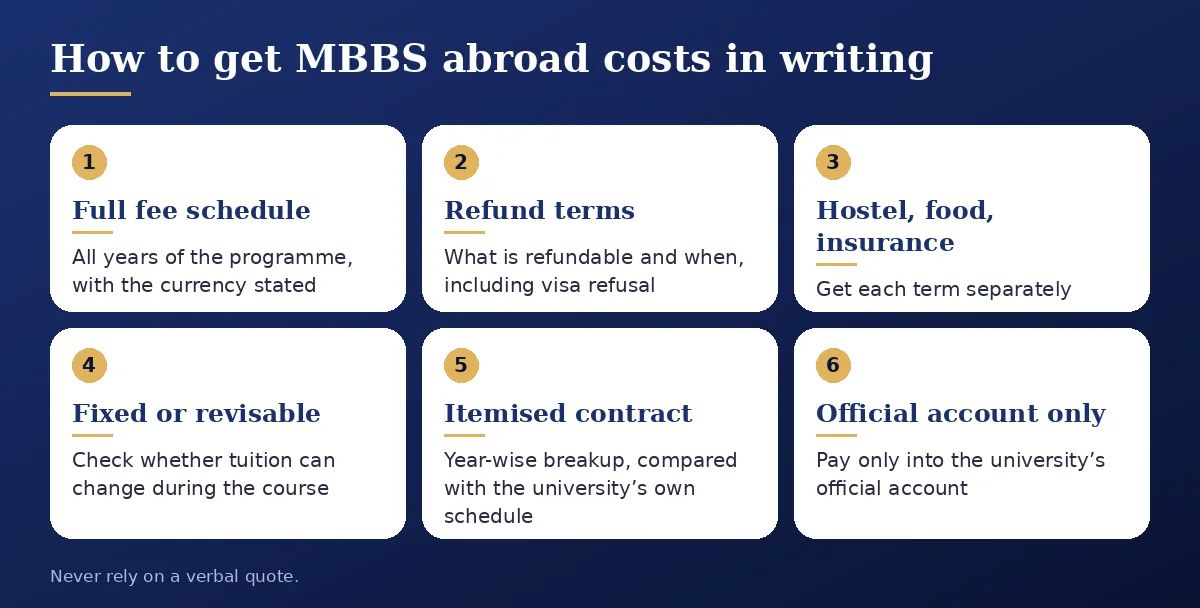
- Ask the university for a fee schedule covering all years of the programme, with the currency stated.
- Ask what is refundable and when, including if the visa is refused or the university’s accreditation changes.
- Get hostel, food and insurance terms separately.
- Check whether tuition is fixed for the whole programme or can be revised.
- Insist on an itemised, year-wise breakup in the contract, as the Embassy of India in Bishkek advises, and compare it with the university’s website.
- Pay only into the university’s official account.
Talk to a counsellor before you decide
We review your NEET result and budget, explain the risks plainly and never promise admission, visas or exam results.
Currency, payment schedule and exchange-rate risk
Tuition is often quoted in US dollars or local currency, while your family earns in rupees. A weaker rupee raises the cost of every instalment, so ask whether fees are fixed in a currency, whether you can pay in advance for several years and what happens to a prepayment if you leave. Keep the reserve for this risk. For some destinations, payment channels and flight routes can also change at short notice, which is why our MBBS in Russia guide flags payment and travel conditions.
Scholarships and education loans
Full scholarships for medicine are competitive and uncommon. Some governments offer quota-based places and some universities offer partial fee waivers based on marks, but be careful with anyone who promises a “guaranteed scholarship” for a fee. Read our guide to study abroad scholarships.
Many families finance MBBS abroad through education loans. Compare interest rates, moratorium periods and collateral requirements across banks, and make sure the loan covers the full six years, because a mid-course funding gap is one of the most stressful problems students face.
Country by country
Costs differ widely, so we compare them with you using written fee schedules from each university. Explore Russia, Georgia, Kazakhstan, Kyrgyzstan, Uzbekistan and the Philippines, and read how to choose the best country for MBBS abroad. For a budget well below this range, see why a full MBBS rarely fits the study abroad under 10 lakhs budget.
Rules and advisories change. Confirm the current position on nmc.org.in and with the university in writing before you pay. We never promise admission, visas or exam results.
Related reading: MBBS in India vs abroad · admission process · the full MBBS abroad guide.

Frequently asked questions
How much does MBBS abroad cost for Indian students?
Published six-year budgets commonly run from about ₹20 lakh to ₹50 lakh or more, depending on country and university. Always get a written fee schedule.
Are there hidden costs in MBBS abroad?
Visa, insurance, flights, living costs, FMGE preparation and the Indian internship can add to tuition. Include them in your budget.
Is the cheapest country the best choice?
Not necessarily. Compliance with NMC rules and teaching quality matter more than the lowest fee.
Can fees increase during the course?
Ask the university whether the fee is fixed for the whole programme and get the answer in writing.
How much reserve should I keep?
A 10% to 15% reserve for currency swings and emergencies is a sensible planning figure.
Is hostel included in the fees?
Sometimes, sometimes not. Confirm in writing what the fee covers and whether hostel is guaranteed every year.
Can I get an education loan for MBBS abroad?
Many families do. Compare interest rates, moratorium and collateral, and make sure the loan covers the full six years.
Can I study MBBS abroad within 10 lakhs?
Published six-year budgets for MBBS usually exceed that, so check every quote for what is excluded and see our study abroad under 10 lakhs guide.
Sources and further reading
Official notices and reports used for this page: National Medical Commission: FMGL Regulations, 2021 and student advisories · Embassy of India, Bishkek: student advisory with the FMGL conditions (updated 23 April 2026) · NBEMS: FMGE notices. Media reports are secondary sources, so confirm each point against the NMC’s own notices and the official advisory pages.
Rules and advisories change. Confirm the current position on nmc.org.in and with the university in writing before you pay. We never promise admission, visas or exam results.