
The MBBS abroad admission process is a sequence of checks, not a rush to pay a deposit: confirm eligibility, shortlist verified programmes, apply, receive an offer, handle the visa and travel. Requirements vary by country and university, so confirm each in writing. This guide walks through each stage in order, with the documents, the questions to ask and the points where families most often lose money or time.
Quick answer: The MBBS abroad admission process runs in seven stages: check eligibility (NEET, Class 12 subjects, NMC conditions), shortlist verified universities, apply with documents, receive and read the offer letter, apply for the student visa, arrange travel and accommodation, then complete arrival and registration. Do not pay until you have the course length in months, the internship arrangement and all costs in writing, and pay only into the university’s official account.
Key facts: the admission process at a glance
| Stages | Eligibility, shortlist, application, offer, visa, pre-departure, arrival and registration |
|---|---|
| Core documents | Passport, Class 10 and 12 records, NEET scorecard, birth certificate, photographs, medical and other certificates |
| Often needed | Attestation, apostille or translation of documents; requirements differ by country |
| Visa | Decisions rest with the authorities, not with consultants or universities |
| Payment rule | Pay only into the university’s official account and keep authentic receipts |
| Contract rule | Get an itemised, year-wise breakup of tuition, hostel, food and other charges before signing |
| Timing | Start document preparation several months before the intake |
| Last reviewed | 18 November 2026 |
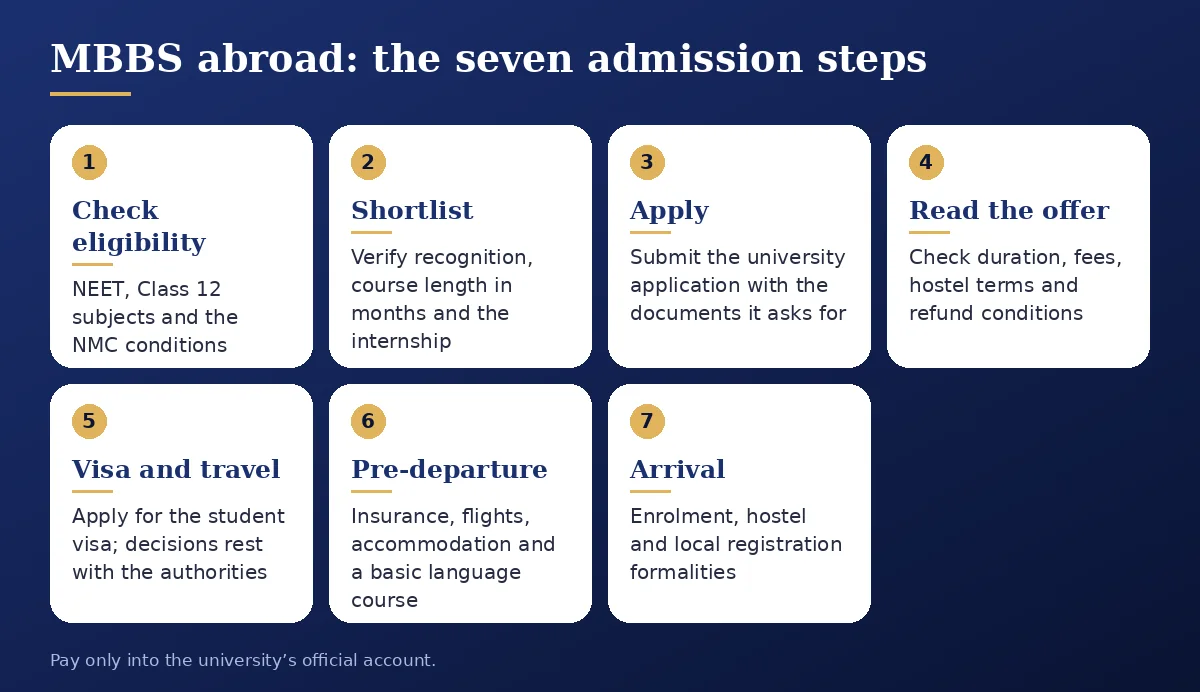
The seven steps in order
- Check eligibility. NEET, Class 12 subjects and the NMC conditions. See eligibility.
- Shortlist universities. Verify recognition, course length in months and the internship. See choosing a university.
- Apply with documents. Submit the university’s application with the documents it asks for.
- Receive and read the offer. Check duration, fees, hostel terms and refund conditions before accepting.
- Visa and travel. Apply for the student visa. Decisions rest with the authorities.
- Pre-departure. Arrange insurance, flights, accommodation and a basic language course.
- Arrival and registration. Complete enrolment, hostel and local registration formalities.
Timelines differ by country and university, so ask for the timeline in writing and work backwards from the intake date. The process is the same in principle everywhere: verify first, pay later.
Steps 1 and 2: eligibility and shortlist
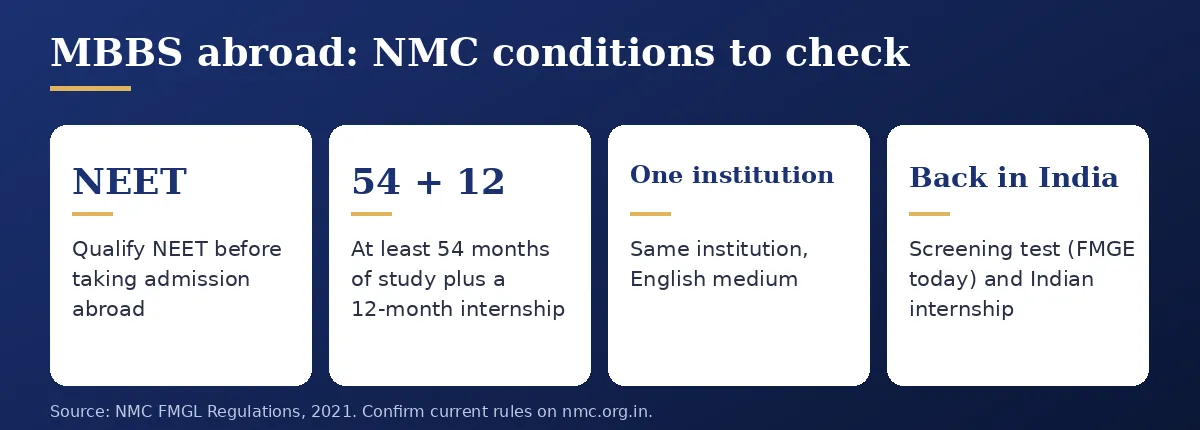
Before any application, confirm that you qualify NEET and that the programme meets the NMC’s conditions:
- NEET qualification before taking admission abroad.
- At least 54 months of medical study, plus a 12-month internship in the same foreign institution.
- The whole course at one institution in one country, taught in English medium.
- Passing India's screening test (the FMGE today) and completing the Indian internship before permanent registration.
Then shortlist three to five universities. For each, ask in writing for the course length in months, the internship location, English-medium confirmation, accreditation proof, FMGE results of Indian graduates and the full fee schedule. Read any advisory for the country first: Uzbekistan, Kyrgyzstan and Georgia each have specific cautions.
Step 3: the documents you will be asked for
| Identity | Valid passport and photographs in the required format; birth certificate and, where requested, parents’ identity documents. |
|---|---|
| Academic | Class 10 and Class 12 mark sheets and certificates; NEET-UG scorecard and admit card. |
| Health | Medical fitness certificate, HIV test and other tests required by the destination country. |
| Legal | Police clearance certificate where required. |
| Financial | Bank statement or sponsor documents showing the funds the visa office asks for. |
| University | Offer or invitation letter and proof of fee payment. |
Lists differ by country, and some documents need attestation, translation or an apostille. For example, the Embassy of India in Manila advised Philippine-bound students to have their degree and academic documents apostilled by the Philippine Department of Foreign Affairs for validity in India. Ask the university for its checklist and start early so a missing stamp does not cost you a year.
Step 4: how to read the offer letter
An offer letter is a contract in practice. Before you accept, check each of these:
- Programme name, degree awarded and duration in months, with the internship shown separately.
- Fees year by year, currency, and whether tuition can increase during the course.
- Hostel, food, insurance and other charges, itemised rather than lumped together.
- Refund conditions if your visa is refused, if you withdraw, or if the university’s accreditation or licence changes.
- The bank account receiving payment, which must belong to the university.
- The language of the contract. The Embassy of India in Bishkek advises an itemised breakup of tuition, accommodation, food and other expenses in the agreement, and comparing it with the university’s website and the official portal.
Send us your offer letter for a plain-language check
We will compare it against the NMC conditions and list the questions to ask before you pay. Free, with no payment or commitment.
Call +91 95400 01774How to pay safely
- Pay tuition and fees directly to the university’s official account and keep authentic receipts.
- Avoid paying seat-blocking fees to personal accounts or agents.
- Use only consultants registered in India, and verify their CIN, TAN and PAN as the Embassy of India in Bishkek advises.
- Do not pay until you have the course length in months, the internship arrangement and all costs in writing.
- Be cautious of anyone who guarantees admission, suggests skipping NEET or rushes you to pay in full.
Our fees guide explains what a real six-year budget includes.
Steps 5 to 7: visa, pre-departure and arrival
Apply for the student visa only after the offer is verified and the contract is clear. The Embassy of India in Bishkek advises students to travel on a student visa only, not any other category. Visa decisions rest with the authorities, and we help you apply with a complete file but cannot guarantee the outcome.
Before you leave, arrange health insurance, flights, accommodation and a basic course in the local language, because patient communication in hospitals is usually in that language even when lectures are in English. On arrival, complete enrolment, hostel and local registration formalities, and keep your passport with you: if anyone other than the university or visa office holds it, tell the university and the Embassy immediately. Our living costs guide covers day-to-day budgeting.
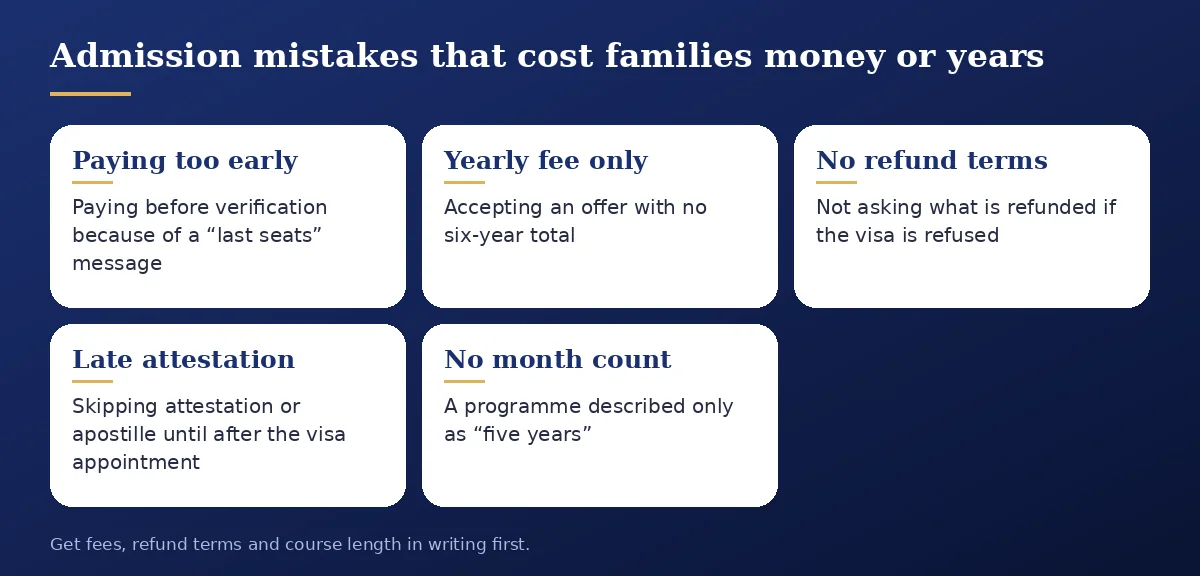
Mistakes that cost families money or years
- Paying before verification because of a “last seats” message.
- Accepting an offer that shows only a yearly fee, with no six-year total.
- Not asking what is refunded if the visa is refused.
- Skipping attestation or apostille until after the visa appointment.
- Choosing a programme described only as “five years” with no month count, or one that substitutes “compensation” certificates for a compliant course length.
Rules and advisories change. Confirm the current position on nmc.org.in and with the university in writing before you pay. We never promise admission, visas or exam results.
Related reading: NMC guidelines for MBBS abroad explained · MBBS abroad after NEET · the full MBBS abroad guide.

Frequently asked questions
How long does MBBS abroad admission take?
It varies by university and country, so ask for the timeline in writing, and start the document preparation several months before the intake.
Which documents are needed for MBBS abroad?
Commonly a passport, Class 10 and 12 records, NEET scorecard, photographs, birth certificate and the medical and other certificates the university asks for. Confirm the exact list.
Do documents need attestation or apostille?
Often. Requirements differ by country, for example the Embassy of India in Manila advised apostille by the Philippine DFA. Ask the university for its checklist.
Can the visa be guaranteed?
No. Visa decisions rest with the authorities. We help you apply with a complete file.
Should I pay a deposit early?
Not before verifying the programme and receiving all terms in writing, and then only to the university’s official account.
How do I check that a consultant is genuine?
The Embassy of India in Bishkek advises using consultants registered in India and verifying their CIN, TAN and PAN before signing.
What should the offer letter show?
Programme duration in months, a year-wise itemised fee breakup, refund conditions and the university’s official bank account.
What if my visa is refused?
Ask in advance what the university refunds. Get the refund terms in writing before paying.
Sources and further reading
Official notices and reports used for this page: National Medical Commission: FMGL Regulations, 2021 and student advisories · Embassy of India, Bishkek: student advisory with the FMGL conditions (updated 23 April 2026) · Embassy of India, Manila: advisory of 17 June 2026. Media reports are secondary sources, so confirm each point against the NMC’s own notices and the official advisory pages.
Rules and advisories change. Confirm the current position on nmc.org.in and with the university in writing before you pay. We never promise admission, visas or exam results.